Do Graphics Processing Units Have Politics?
In the middle of the 20th century, computer science researchers began to explore what it would take to produce a responsive graphical interface to mediate the interactions between people and computers. By the mid-1980s, the results of this research took on the form of the graphics processing unit, or GPU.
Do Graphics Processing Units Have Politics? traces this story back to its roots at the University of Utah, and then continues on to the early 2010s, when a different group of computing researchers stumbled across the startling efficacy of GPUs for what had been for decades a mostly unpopular and only moderately successful set of methods for developing ‘artificial intelligence’ programs: artificial neural networks. The collision between GPUs and neural networks electrified the computer science world, leading to the AI renaissance in which we currently find ourselves in the early 2020s. But the mesh between GPUs and neural networks requires a third ingredient: training data, and lots of it. Who produces that training data? And what does the production of training data mean for AI’s promises of automation?
This project owes many debts - in particular to Jacob Gaboury’s Image Objects: An Archaeology of Computer Graphics, Mary Gray & Siddarth Suri’s Ghost Work: How to Stop Silicon Valley from Building a New Global Underclass, Phil Jones’ Work Without the Worker: Labour in the Age of Platform Capitalism, and papers by Lily Irani, Moritz Altenreid, Tim Hwang, and Sarah Hooker, among others. (A full bibliography can be found here.)
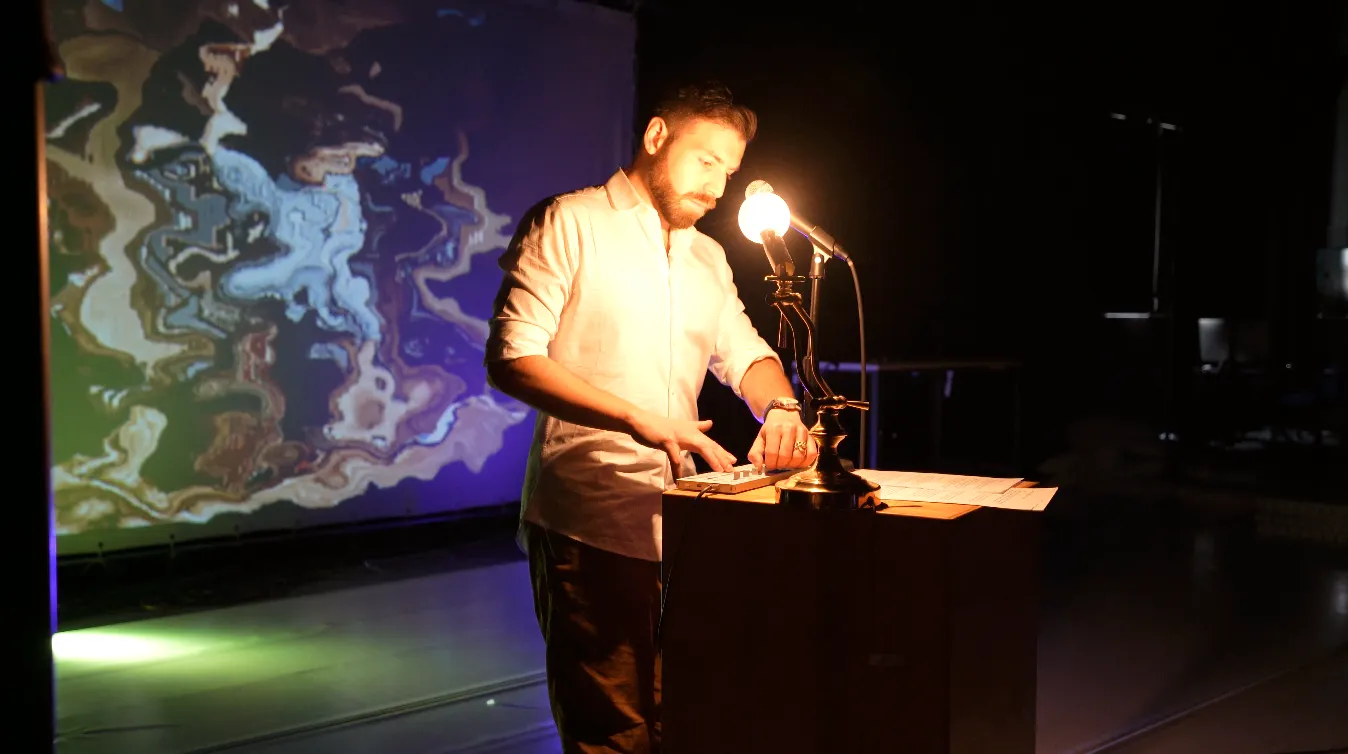
Note: the animated images projected during this performance are being generated in real-time using the signal from the synthesizer played onstage to ping a neural network trained on the same ImageNet dataset discussed in the performance.
Performance created by Ben Gansky, with visuals by Shawn Lawson.
Developed with support from the Experimental Humanities Collaborative Network and Tamarack Arts Center. Awarded Honorable Mention by the Society for the Social Studies of Science Making & Doing Section (2022).